What is Mailjet?
Mailjet is an email platform that handles both transactional messages sent from an app and marketing campaigns built by a team. Developers send through a REST API or SMTP relay, while marketers use a drag-and-drop editor, segmentation and automation. The company was founded in 2010, has European roots and now runs as part of Sinch, branded Sinch Mailjet. Its EU-based data centers make it a common pick for teams with GDPR concerns.
The product is split across two audiences that share one account. Engineering teams get webhooks, inbound parsing and SDKs for languages such as PHP, Python, Node and Java. Marketing teams get real-time co-editing, comments and approvals before a campaign goes out. Newer AI tools help draft copy and build segments, and an MCP server lets AI assistants work with the account.
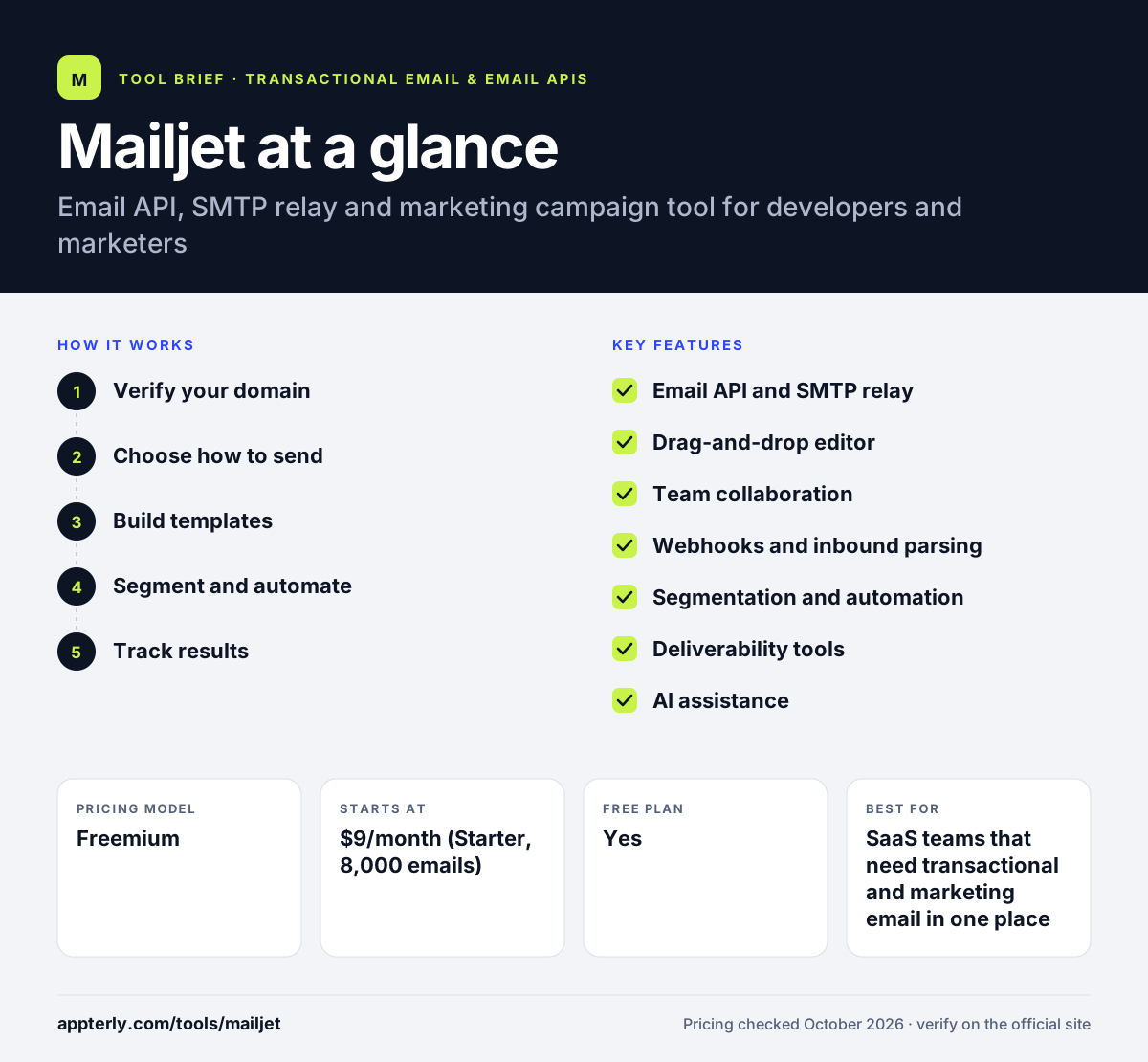
Mailjet at a glance
How does Mailjet work?
- Verify your domain
Add your sending domain and set up authentication records so mailbox providers trust your messages.
- Choose how to send
Connect your app through the REST API or SMTP relay, or build campaigns in the visual editor.
- Build templates
Design reusable templates with the drag-and-drop editor, then inject variables per recipient through the API.
- Segment and automate
On higher plans, group contacts into segments and set up automation workflows for follow-ups.
- Track results
Watch opens, clicks, bounces and blocks in real time, or receive the events through webhooks.
Mailjet key features
Email API and SMTP relay
Send transactional and bulk email at any volume through REST or SMTP, with libraries for common languages.
Drag-and-drop editor
Build responsive emails without code and save them as shared templates.
Team collaboration
Several people can edit the same email at once, leave comments and approve it before sending.
Webhooks and inbound parsing
Receive delivery, open, click and bounce events in real time and process incoming email in code.
Segmentation and automation
Target contacts by data and behavior, and run automated workflows on the Premium plan.
Deliverability tools
Email previews, address validation, domain authentication and dedicated IPs for large senders.
AI assistance
AI helps generate email content and segments, and an MCP server connects AI assistants.
Why use Mailjet?
- One account covers both app-triggered email and newsletters, so teams avoid paying for two tools.
- The free plan allows 6,000 emails a month with API, SMTP and webhooks included.
- Real-time co-editing and approvals suit teams where several people touch each campaign.
- EU data centers help companies that want customer data kept in Europe.
- Subaccounts make it easier to separate brands, clients or environments.
Who is Mailjet best for?
A good fit for
- SaaS teams that need transactional and marketing email in one place
- European businesses focused on GDPR
- Marketing teams that review campaigns together
- Small businesses starting on a free plan
Less suited to
- High-volume senders on the free plan, which caps sending at 200 emails a day
- Teams that need automation on a budget, since it starts on Premium
- Brands that need advanced ecommerce flows like a dedicated ecommerce email tool
Mailjet pricing
| Pricing model | Freemium |
|---|---|
| Free plan | Yes |
| Free trial | Not confirmed |
| Starting price | $9/month (Starter, 8,000 emails) |
Essential at $19/month adds unlimited contacts and segmentation, and Premium at $29/month adds automation, landing pages and up to 20 subaccounts. Annual billing saves 10%, extra emails are billed and unused credits expire each cycle.
Prices checked October 2026. Vendors change plans often, so confirm on the official Mailjet pricing page before you buy.
Mailjet pros and cons
Pros
- Free plan includes API, SMTP relay and webhooks
- Strong collaboration tools for marketing teams
- SDKs for many programming languages
- EU data hosting
Cons
- Automation and landing pages require the Premium plan
- Free plan has a 200-email daily cap and Mailjet branding
- Unused email credits do not roll over
Mailjet integrations and platforms
Works with
Available on
Mailjet alternatives
See the full shortlist in Best Transactional Email Services.
Mailjet FAQ
Is Mailjet free?
Yes. Mailjet has a free plan with 6,000 emails a month, a limit of 200 emails a day and up to 1,000 contacts. It includes the API, SMTP relay, webhooks, the email editor and a form builder. No credit card is needed to sign up. Paid plans start at $9 a month and remove the daily cap.
What is Mailjet used for?
Mailjet is used to send two kinds of email. Developers use its API or SMTP relay for transactional messages such as password resets, receipts and alerts. Marketers use its editor, segmentation and automation to send newsletters and promotional campaigns. Both can run from the same Mailjet account.
Is Mailjet good for beginners?
Mailjet is fairly approachable. The drag-and-drop editor and template library let beginners build emails without code, and the free plan is enough to learn the basics. Developers new to email APIs also get documentation and ready-made libraries. Advanced features such as automation sit on higher tiers, so beginners may outgrow the free plan.
Mailjet vs SendGrid: what's the difference?
Both offer an email API, SMTP relay and marketing tools. Mailjet has a permanent free plan, EU data centers and strong real-time collaboration for marketing teams. SendGrid, part of Twilio, focuses on very high sending volume and offers a 60-day free trial rather than an ongoing free API plan. Pricing structures also differ by tier.
Does Mailjet integrate with Shopify?
Yes. Mailjet lists Shopify among its integrations, along with WooCommerce, WordPress and HubSpot. Connecting a store lets you sync customer contacts into Mailjet for campaigns. Mailjet says it offers more than 100 integrations in total, and developers can build custom connections through its API.
Sources
This overview is based on Mailjet's official website and documentation, checked October 2026.