What is Leonardo.ai?
Leonardo.ai is a generative AI platform for creating images and videos from text prompts and reference images, with built-in tools for editing, upscaling and character consistency. It was founded in Australia in late 2022 and gained a following among game artists, illustrators and marketers before Canva announced it would acquire the company in 2024.
Leonardo.ai mixes its own models, such as Phoenix and Lucid, with third-party models including FLUX, GPT Image, Ideogram, Nano Banana and Seedream for images, and Veo, Kling, Wan and Seedance for video. Usage runs on tokens: free users get a daily allowance, while paid plans include a monthly pool that partly rolls over. A separate developer API covers images, video, audio and 3D.
Leonardo.ai at a glance
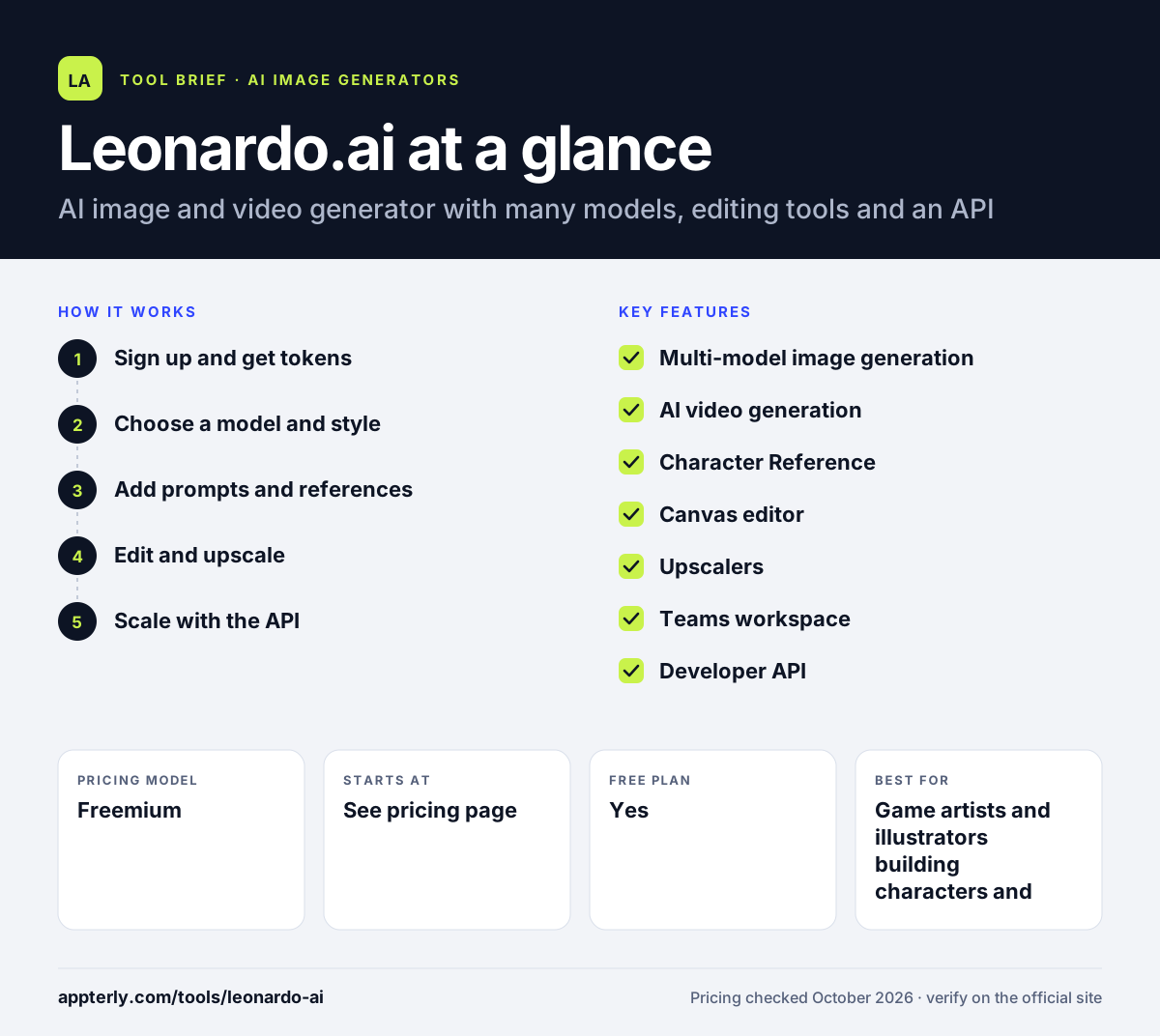
How does Leonardo.ai work?
- Sign up and get tokens
Create an account to receive daily free tokens, or choose a paid plan for a larger monthly allowance.
- Choose a model and style
Pick an image or video model and optional style presets. The token cost appears on the generate button.
- Add prompts and references
Write a prompt and add reference images, such as a character reference, to guide the output.
- Edit and upscale
Refine results in the Canvas editor and use the upscalers to increase resolution and detail.
- Scale with the API
Developers buy API credits separately and send generation requests, with webhooks for finished jobs.
Leonardo.ai key features
Multi-model image generation
Offers Leonardo's Phoenix and Lucid models plus FLUX, GPT Image, Ideogram, Nano Banana and Seedream.
AI video generation
Creates video with models such as Veo 3.1, Kling, Wan, Seedance, Hailuo and Leonardo's Motion.
Character Reference
Keeps one character consistent across different styles, locations and poses.
Canvas editor
An image-editing workspace for refining generated or uploaded images and generating new elements in place.
Upscalers
Several upscaling options increase resolution and detail for final assets.
Teams workspace
Leonardo for Teams adds shared workspaces and team billing.
Developer API
Covers image, video, audio and 3D generation, with SDKs, webhooks and an MCP server.
Token rollover bank
Unused paid tokens move into a bank that holds up to three months of allowance, used after monthly tokens run out.
Why use Leonardo.ai?
- Daily free tokens let you test many models without paying.
- Access to both in-house and third-party models in one place reduces tool switching.
- Character Reference helps keep mascots and characters consistent across campaigns.
- Unused paid tokens roll into a bank holding up to three months of allowance.
- The API lets developers build the same generation features into their own apps.
Who is Leonardo.ai best for?
A good fit for
- Game artists and illustrators building characters and concept art
- Marketers producing social images and short AI videos
- Content creators who want many models in one interface
- Developers building image or video features through an API
Less suited to
- Users who want simple, flat monthly pricing without tokens
- Professional video editors who need timeline editing
- Teams that rely on Canva Business for Leonardo access, since that bundle has ended
Leonardo.ai pricing
| Pricing model | Freemium |
|---|---|
| Free plan | Yes |
| Free trial | Not confirmed |
| Starting price | See the official pricing page |
The free plan gives 150 tokens per day. Paid tiers (Essential, Premium and Ultimate) add monthly tokens, rollover and top-ups, and Premium and Ultimate include slower unlimited generations. API usage is billed separately.
Prices checked October 2026. Vendors change plans often, so confirm on the official Leonardo.ai pricing page before you buy.
Leonardo.ai pros and cons
Pros
- Generous daily free tokens
- Wide choice of image and video models
- Character consistency and Canvas editing tools
- Full developer API with SDKs and webhooks
Cons
- Token costs vary by model and setting, which makes budgeting harder
- Free daily tokens expire and do not carry over
- API access requires separate credits from the web subscription
Leonardo.ai integrations and platforms
Works with
Available on
Leonardo.ai alternatives
See the full shortlist in Best AI Image Generators.
Leonardo.ai FAQ
Is Leonardo.ai free?
Yes. Leonardo.ai has a free plan that gives 150 tokens per day. Tokens are spent on generations, and the cost depends on the model, image size and settings. Unused free tokens expire daily. Paid plans named Essential, Premium and Ultimate add a larger monthly allowance and more features. Paid plans also allow top-up packs that do not expire while you stay subscribed.
Who owns Leonardo.ai?
Canva announced in July 2024 that it would acquire Leonardo.Ai, an Australian generative AI company founded in late 2022. Leonardo still runs as its own platform with separate plans, and users can sign in with a Canva account. Canva Business no longer bundles Leonardo Essential access for new subscribers. Its core team was based in Australia when the deal was announced.
What is Leonardo.ai used for?
Leonardo.ai is used to create images and short videos from prompts, design consistent characters, edit and extend images on a canvas, and upscale assets. Game studios, illustrators, marketers and social creators use it, and developers use its API to add generation to their own products. Many users combine it with Canva for layout and final design work.
Leonardo.ai vs Midjourney: what's the difference?
Midjourney focuses on its own image and video models and requires a paid plan from the start. Leonardo.ai offers a free daily token allowance, many in-house and third-party models, a Canvas editor and a developer API. Leonardo suits users who want more tools and model choice in one place. Leonardo also gives users more control over model choice per project.
Does Leonardo.ai have an API?
Yes. The Leonardo.ai API supports image, video, audio and 3D generation, with webhooks, SDKs and an MCP server. API access is billed separately from web app subscriptions, so you buy API credits and create a key from the API Access page before sending requests. Developers can export a web app generation as ready-to-use API code.
Sources
This overview is based on Leonardo.ai's official website and documentation, checked October 2026.
- docs.leonardo.ai/docs/getting-started
- intercom.help/leonardo-ai/en/articles/9044700-tokens-faq
- intercom.help/leonardo-ai/en/articles/8044033-token-usage
- intercom.help/leonardo-ai/en/
- www.canva.com/help/leonardo-entitlement-update/
- www.businesswire.com/news/home/20240729977410/en/Canva-to-Acquire-Generative-AI-Platform-Leonardo.AI-to-Bring-Leading-Visual-AI-to-Every-Organization