What is ChatGPT?
ChatGPT is an AI assistant from OpenAI that answers questions, writes and edits text, analyzes files and creates images through a chat interface. Marketers use it to draft blog posts, ad variations, emails and social captions, brainstorm campaign ideas and summarize research. It runs on OpenAI's GPT-5.5 models, with faster Instant and deeper Thinking modes depending on the plan.
ChatGPT also includes ChatGPT Images, which generates and edits pictures from text prompts inside the same conversation. Paid plans add deep research, agent mode, projects, custom GPTs, longer memory and more uploads, while Business and Enterprise plans add shared workspaces, admin controls and a promise not to train on company data. Apps are available on the web, desktop and mobile.
ChatGPT at a glance
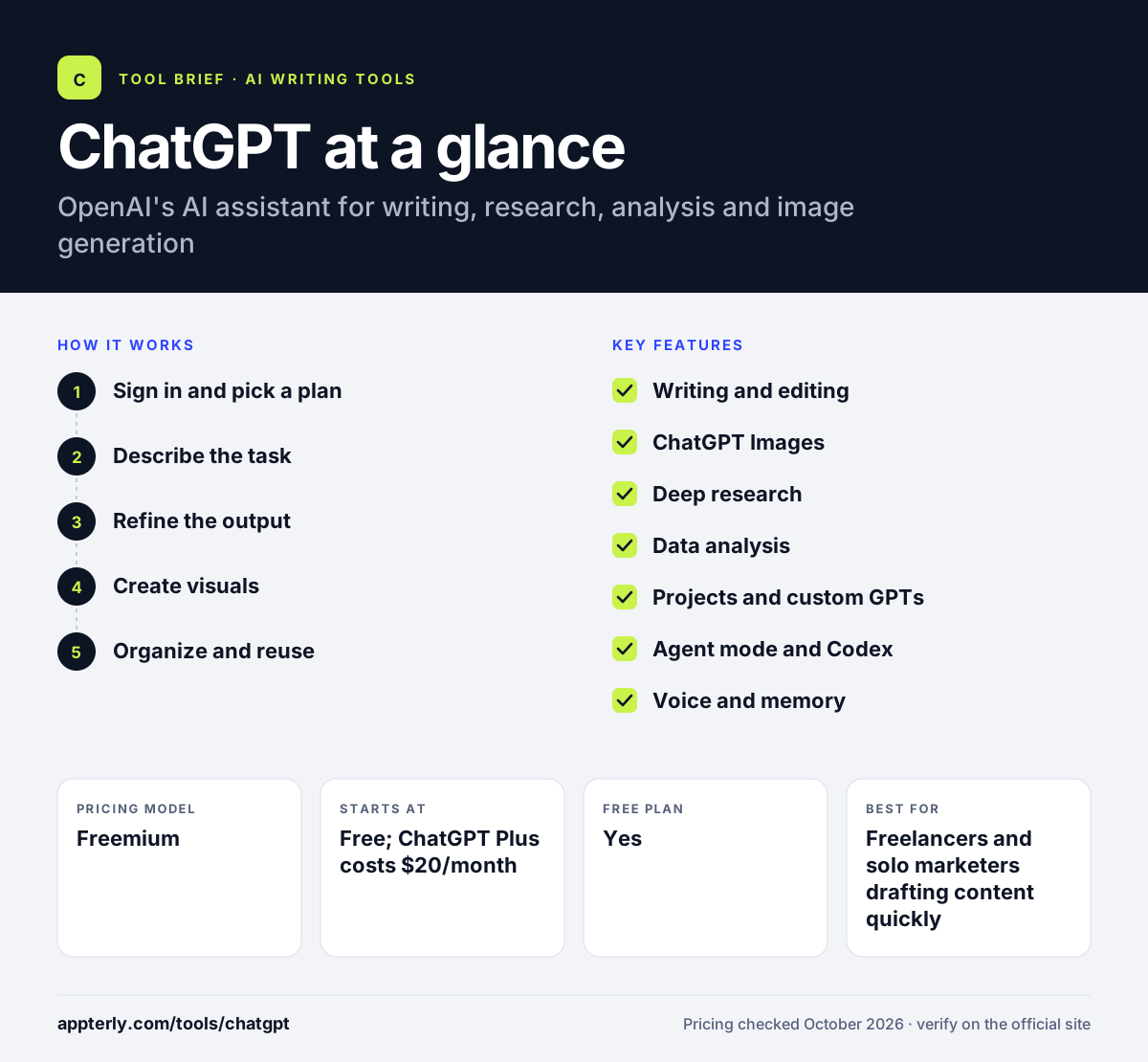
How does ChatGPT work?
- Sign in and pick a plan
Create a free account on the web or in the app, or upgrade to Go, Plus or Pro for higher limits and stronger models.
- Describe the task
Type or speak a request, such as a blog outline or ad variations, and attach files, images or data when needed. Clear context about audience and goal improves the result.
- Refine the output
Ask follow-up questions, change tone or length, or switch to Thinking mode for harder reasoning tasks.
- Create visuals
Ask ChatGPT Images for a graphic or upload an image to edit, then iterate in the same chat.
- Organize and reuse
Save context in projects, build custom GPTs for repeat tasks, and let memory keep your preferences.
ChatGPT key features
Writing and editing
Drafts, rewrites and summarizes content in many formats, from emails to long-form articles.
ChatGPT Images
Creates and edits images from prompts; paid plans get more generations and image creation with Thinking.
Deep research
Runs multi-step web research and returns a structured report, with expanded limits on paid plans.
Data analysis
Reads uploaded spreadsheets and files to build summaries, charts and insights.
Projects and custom GPTs
Groups chats and files by project and lets you build reusable assistants for specific tasks on Plus and above.
Agent mode and Codex
Agent mode completes multi-step tasks, and Codex helps with coding work, with limits that rise by plan.
Voice and memory
Talk to ChatGPT by voice and let it remember preferences across conversations.
Why use ChatGPT?
- One tool covers writing, research, analysis and image creation.
- The free plan is enough to test most everyday marketing tasks.
- Apps on web, desktop and mobile keep work available everywhere.
- Custom GPTs and projects make repeat content tasks faster.
- Business plans add admin controls and keep company data out of training.
Who is ChatGPT best for?
A good fit for
- Freelancers and solo marketers drafting content quickly
- Small teams that want one AI assistant for many tasks
- Founders doing research, planning and copywriting themselves
- Agencies building reusable GPTs for client workflows
Less suited to
- Teams needing built-in SEO data, rank tracking or keyword volumes
- Workflows that require guaranteed factual accuracy without human review
ChatGPT pricing
| Pricing model | Freemium |
|---|---|
| Free plan | Yes |
| Free trial | Not confirmed |
| Starting price | Free; ChatGPT Plus costs $20/month |
Go, Plus and Pro raise usage limits and unlock stronger models, deep research and agent mode. Business is billed per user with a two-seat minimum, and Enterprise is priced through sales.
Prices checked October 2026. Vendors change plans often, so confirm on the official ChatGPT pricing page before you buy.
ChatGPT pros and cons
Pros
- Very capable free plan
- Text, images, research and data analysis in one place
- Available on nearly every device
- Custom GPTs make repeat tasks easy to standardize
Cons
- Output still needs fact-checking and editing
- Free and Go plans have tight limits on advanced features
- No native SEO metrics such as search volume or rankings
ChatGPT integrations and platforms
Available on
ChatGPT alternatives
See the full shortlist in Best AI Writing Tools.
ChatGPT FAQ
Is ChatGPT free?
Yes. ChatGPT has a free plan with limited access to GPT-5.5 Instant, file uploads, deep research, memory and image creation. Paid plans such as Go, Plus and Pro raise these limits, and Plus costs $20 per month. Business and Enterprise plans are designed for teams and companies.
What is ChatGPT used for in marketing?
Marketers use ChatGPT to draft blog posts, ad copy, emails and social captions, brainstorm campaign ideas, summarize research and analyze spreadsheets. ChatGPT Images can create simple visuals and edit pictures. All output should be reviewed for accuracy and brand fit before publishing.
Can ChatGPT create images?
Yes. ChatGPT Images lets you generate pictures from a text prompt or upload an image and ask for edits, all inside a normal chat. Free users get limited and slower generation, while Plus and Pro get more capacity and image creation with Thinking for more complex, accurate results.
ChatGPT vs Claude: what's the difference?
Both are general AI assistants for writing, research and analysis. ChatGPT includes built-in image generation, custom GPTs and a Chrome extension, while Anthropic's Claude focuses on long documents, file creation and connectors to work apps. Many marketers try the free plan of each and keep the one that fits their workflow.
Is ChatGPT good for beginners?
Yes. ChatGPT works through plain-language chat, so there is nothing to configure before you start. Beginners can ask for a draft, then ask for changes in follow-up messages. The free plan is enough to learn the basics before deciding whether a paid plan is worth it.
Sources
This overview is based on ChatGPT's official website and documentation, checked October 2026.