What is Transistor?
Transistor is a podcast hosting and distribution platform that stores your episodes, publishes your RSS feed and sends your show to apps like Apple Podcasts, Spotify and YouTube. It was launched in 2018 by Jon Buda and Justin Jackson. Every plan lets you host as many podcasts as you want and add as many team members as you need, so pricing depends on downloads rather than on the number of shows.
Beyond public shows, Transistor supports private, members-only podcasts for companies, courses and paid communities, with each listener getting a personal feed. It also builds a website for each show, offers audience analytics, and on higher plans adds dynamic ad insertion and automatic posting to YouTube. An API and an MCP server let teams connect it to their own tools and AI assistants.
Transistor at a glance
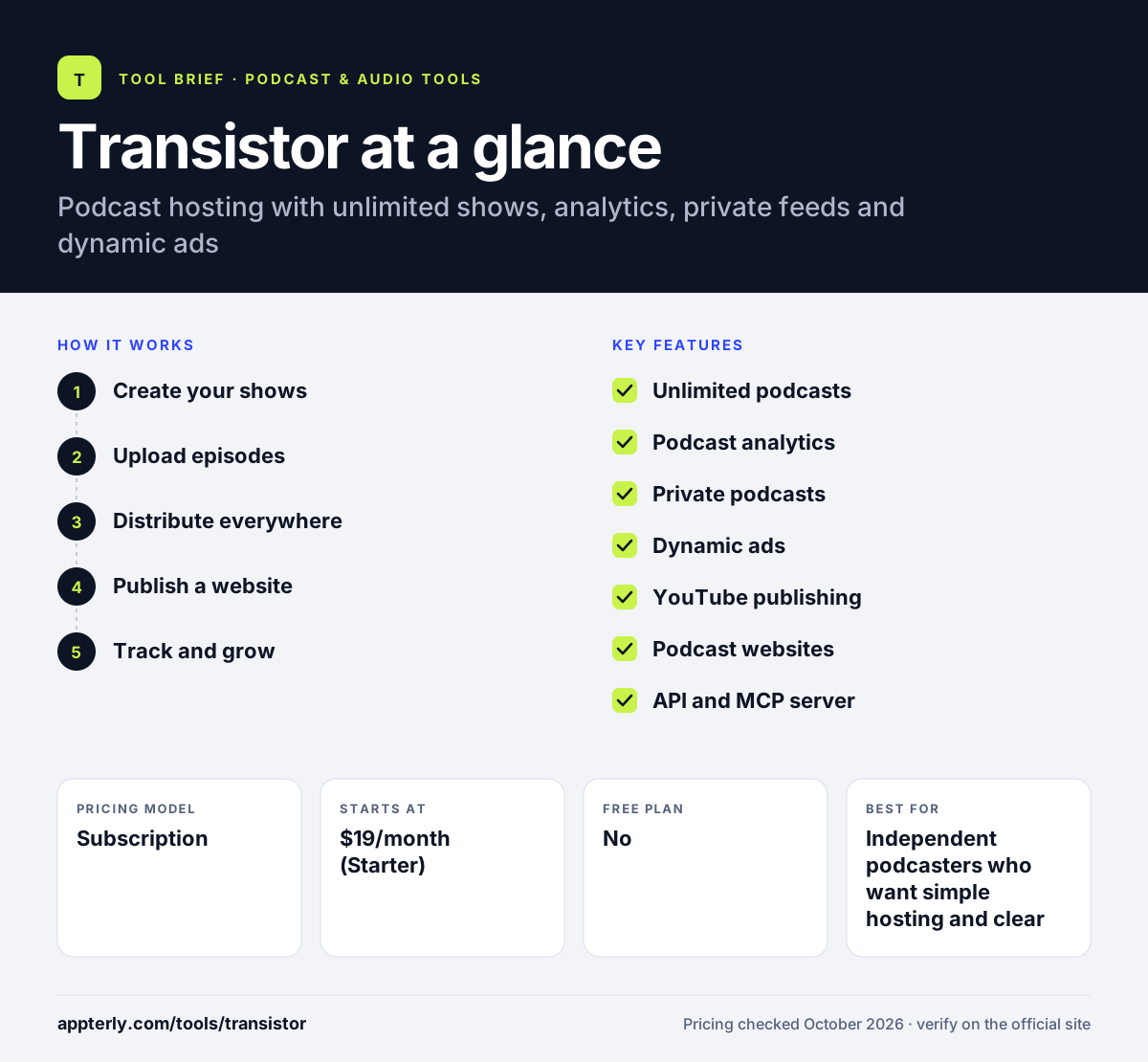
How does Transistor work?
- Create your shows
Set up one or more podcasts in a single account, add artwork and details, and invite co-hosts or producers as team members.
- Upload episodes
Upload audio or video episodes once, add show notes and schedule them to publish when you want.
- Distribute everywhere
Use the distribution dashboard to submit your feed to Apple Podcasts, Spotify, YouTube, Overcast, Pocket Casts and other apps.
- Publish a website
Pick a design and Transistor generates a podcast website, with a network site option for companies running several shows.
- Track and grow
Review downloads per episode, top listening apps and subscriber trends, then adjust your publishing and promotion.
Transistor key features
Unlimited podcasts
Host as many shows as you like on one plan, which suits networks, agencies and companies with several series.
Podcast analytics
See average downloads per episode, popular listening apps, estimated subscribers and long-term trends in one dashboard.
Private podcasts
Run internal or paid shows with unique feeds per listener. Add subscribers by hand, by CSV, by invite link or through Zapier, or sync paying members from Ghost.
Dynamic ads
Insert pre-roll, mid-roll and post-roll ads across your back catalog on the Professional plan and above.
YouTube publishing
Publish episodes to YouTube, with automatic posting included on Professional and Business plans.
Podcast websites
Get a ready-made website for each show plus a network website, with branding removal on the Business plan.
API and MCP server
Use the API on every plan to automate uploads or pull analytics, or connect AI assistants through the MCP server.
Why use Transistor?
- You can run several shows without paying per podcast, since every plan includes unlimited shows.
- Unlimited team members make it easy to give producers, editors and co-hosts their own access.
- Private podcasts give companies and creators a simple way to deliver audio to employees or paying members.
- Dynamic ads let you sell sponsorships across old and new episodes without re-editing files.
- Integrations with email tools and automation platforms help you connect the podcast to the rest of your marketing.
Who is Transistor best for?
A good fit for
- Independent podcasters who want simple hosting and clear analytics
- Companies running internal or branded podcasts
- Agencies and networks managing several shows
- Course creators and membership sites selling private audio
Less suited to
- Hobbyists who want a free hosting plan, since Transistor has none
- Creators who need built-in recording or editing, which Transistor leaves to tools like Riverside or Descript
- Private podcast listeners on Spotify, which does not support Transistor private feeds
Transistor pricing
| Pricing model | Subscription |
|---|---|
| Free plan | No |
| Free trial | 14 days |
| Starting price | $19/month (Starter) |
Plans step up by monthly download limits and private subscriber caps: Starter $19, Professional $49 and Business $99 per month, with Enterprise from $199. Yearly billing gives 12 months for the price of 10, and transcription is a paid add-on.
Prices checked October 2026. Vendors change plans often, so confirm on the official Transistor pricing page before you buy.
Transistor pros and cons
Pros
- Unlimited shows and team members on every plan
- Strong private podcast features with Ghost and Zapier support
- API access and a generated website included from the entry plan
- Clear, download-based pricing tiers
Cons
- No free plan, only a 14-day trial
- Dynamic ads and YouTube auto-posting require the $49 plan or higher
- No built-in recording or audio editing
Transistor integrations and platforms
Works with
Available on
Transistor alternatives
See the full shortlist in Best Podcast Software.
Transistor FAQ
Is Transistor free?
No. Transistor does not have a free plan. It offers a 14-day free trial, after which plans start at $19 per month for the Starter tier. Paying yearly gives you 12 months for the price of 10. Every plan includes unlimited podcasts, unlimited team members, analytics, a podcast website and API access.
What is Transistor used for?
Transistor is used to host podcast episodes, publish the RSS feed and distribute shows to apps like Apple Podcasts, Spotify and YouTube. Businesses also use it for private podcasts that only employees or paying members can hear, and podcasters use it to track downloads and insert dynamic ads.
Can I host multiple podcasts on Transistor?
Yes. Every Transistor plan includes unlimited podcasts, so you can run several shows from one account without paying more per show. What changes between plans is the total monthly download allowance and the number of private podcast subscribers, along with extras like dynamic ads and branding removal.
Transistor vs Buzzsprout: what's the difference?
Buzzsprout offers a limited free plan and builds its paid plans around upload hours and a set number of shows. Transistor has no free plan, prices by monthly downloads and includes unlimited shows and team members on every tier. That makes Transistor a better fit for companies, networks and private podcasts, while Buzzsprout suits single-show beginners.
Does Transistor support private podcasts?
Yes. Transistor lets you create private podcasts where each listener gets a unique RSS feed. You can add subscribers manually, by CSV upload, through invite links or with Zapier, and Ghost members can be synced automatically. Private feeds work in apps like Apple Podcasts, Overcast and Pocket Casts, but not in Spotify.
Sources
This overview is based on Transistor's official website and documentation, checked October 2026.