What is ReferralCandy?
ReferralCandy is a referral and affiliate marketing platform that helps online stores turn customers, creators and partners into a sales channel. Shoppers get a personal link or code to share, their friends receive a discount, and the referrer earns a reward when a purchase is made. The tool is built mainly for Shopify, and it also supports WooCommerce, BigCommerce, Magento and custom stores.
Along with classic refer-a-friend campaigns, ReferralCandy runs affiliate programs that pay commission, creator programs with personal codes and simple store-credit loyalty. It handles fraud checks, reward emails, payouts and analytics. An AI agent called REx can read your store, draft a program and suggest changes, which you approve before they go live. The company was founded in 2010 by Dinesh Raju and Zach Cheng.
ReferralCandy at a glance
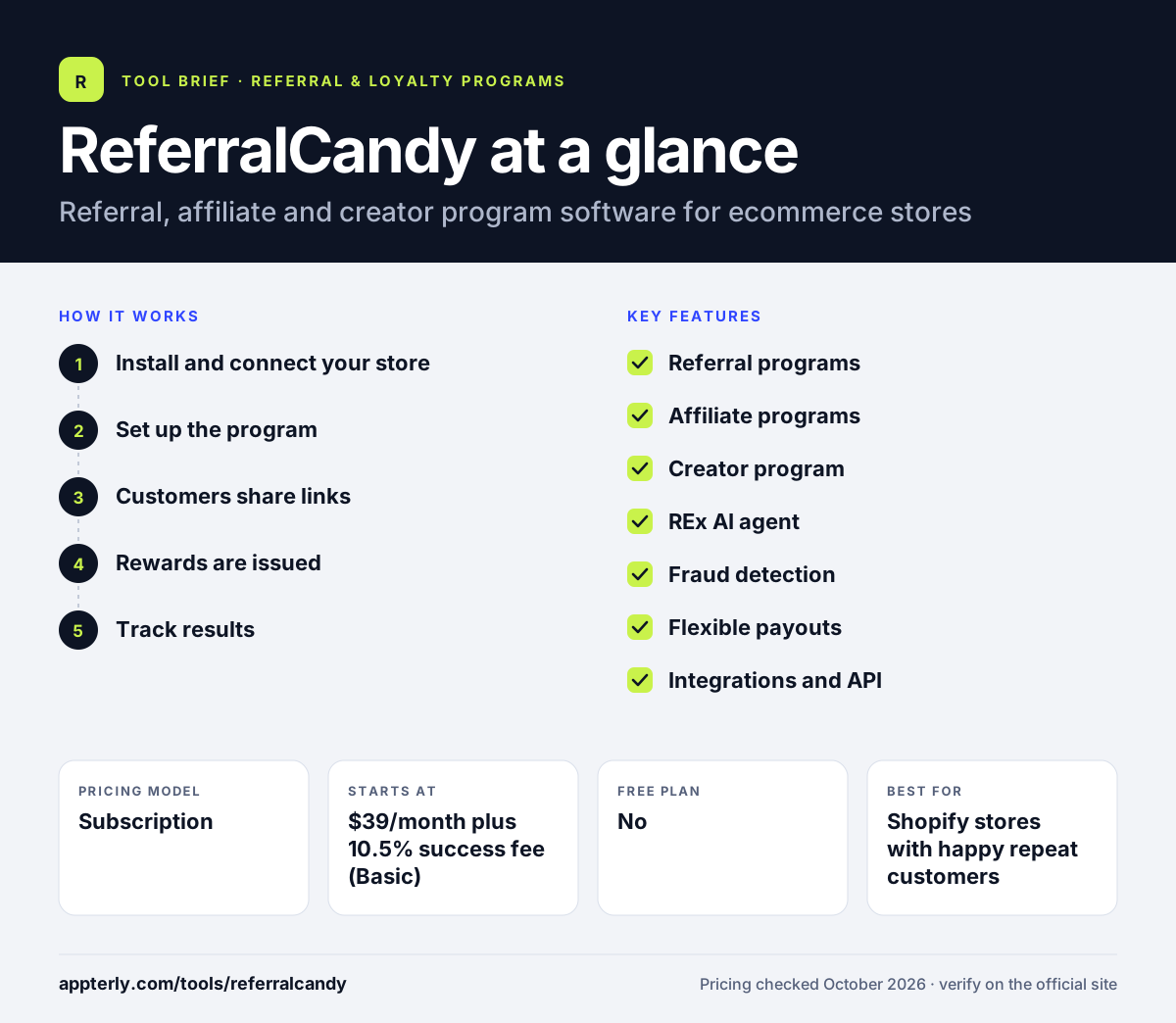
How does ReferralCandy work?
- Install and connect your store
Add the Shopify app with one click or connect WooCommerce, BigCommerce, Magento or a custom store through plugins or email-based tracking.
- Set up the program
Pick referral, affiliate or creator rewards, or let the REx agent draft a program based on your store for you to review.
- Customers share links
After purchase, customers get a unique link or code by email and on a referral page, and they share it with friends.
- Rewards are issued
When a referred friend buys, ReferralCandy tracks the order, runs fraud checks and pays the referrer by discount, store credit, PayPal, Venmo, bank transfer or virtual card.
- Track results
The dashboard shows referred revenue, top advocates and campaign performance so you can tweak rewards.
ReferralCandy key features
Referral programs
Two-sided rewards give both the customer and their friend an incentive to buy.
Affiliate programs
Publishers and partners earn commission on sales they send, with tracking and payouts built in.
Creator program
Creators share their own discount code with followers, which suits influencer-style partnerships.
REx AI agent
Reads your store, drafts programs and recommends changes, with the merchant approving every action.
Fraud detection
Automatic checks help stop self-referrals and abuse before rewards go out.
Flexible payouts
Rewards can be paid as discounts, store credit, PayPal, Venmo, bank transfer or Tremendous virtual debit cards.
Integrations and API
Connects with Klaviyo, Recharge, Omnisend, Mailchimp and Google Analytics, plus a REST API.
Why use ReferralCandy?
- Word-of-mouth referrals bring in new customers at a cost tied to actual sales.
- Referral, affiliate and creator programs live in one tool instead of three.
- Every plan includes all features, so small stores do not lose functionality.
- Built-in fraud checks and payouts cut the manual work of running a program.
- Month-to-month billing with no contract keeps the commitment low.
Who is ReferralCandy best for?
A good fit for
- Shopify stores with happy repeat customers
- DTC brands working with creators and affiliates
- WooCommerce and BigCommerce merchants wanting a referral app
- Subscription brands using Recharge
Less suited to
- Brands that want a full points-and-tiers loyalty program
- Stores with low margins, since success fees add to every referred sale
- Non-ecommerce businesses such as SaaS lead generation
ReferralCandy pricing
| Pricing model | Subscription |
|---|---|
| Free plan | No |
| Free trial | 7 days |
| Starting price | $39/month plus 10.5% success fee (Basic) |
Plans differ only by monthly fee and success-fee rate: Grow is $79 plus 3.5%, Scale $249 plus 1.5% and Enterprise $799 plus 0.25%. Success fees apply to referred new customers' first three orders.
Prices checked October 2026. Vendors change plans often, so confirm on the official ReferralCandy pricing page before you buy.
ReferralCandy pros and cons
Pros
- All features included on every plan
- Covers referrals, affiliates and creators in one place
- No contract and a 7-day free trial
- Multiple payout methods, including store credit and virtual cards
Cons
- Success fees can add up for stores with high referral volume on lower plans
- Loyalty features are basic compared with dedicated loyalty apps
ReferralCandy integrations and platforms
Works with
Available on
ReferralCandy alternatives
See the full shortlist in Best Referral and Loyalty Software.
ReferralCandy FAQ
How much does ReferralCandy cost?
ReferralCandy plans start at $39 per month plus a 10.5% success fee on the Basic plan. Grow costs $79 plus 3.5%, Scale $249 plus 1.5% and Enterprise $799 plus 0.25%. The success fee only applies to a referred new customer's first three orders. Plans are month to month with a 7-day free trial.
Is ReferralCandy only for Shopify?
No. ReferralCandy offers a one-click Shopify app, but it also works with WooCommerce, BigCommerce, Magento and custom-built stores. Non-Shopify stores connect through plugins or an email-based setup. Pricing is the same on every platform, and all plans include the full feature set and integrations.
What is ReferralCandy used for?
ReferralCandy is used to run customer referral programs for online stores. It gives buyers a link to share, rewards them when friends purchase and handles tracking, fraud checks and payouts. Brands also use it to manage affiliate partners and creators who promote the store with their own codes.
ReferralCandy vs Viral Loops: what's the difference?
ReferralCandy is built for ecommerce stores and charges a monthly fee plus a success fee on referred sales. Viral Loops is a template-based referral tool for many business types, including prelaunch waitlists, newsletters and giveaways, and it charges by the number of campaign participants. Ecommerce brands often prefer ReferralCandy, while startups and newsletters lean toward Viral Loops.
Does ReferralCandy integrate with Klaviyo?
Yes. ReferralCandy integrates with Klaviyo so referral data and links can be used in email flows. It also connects with Omnisend, Mailchimp, Recharge and Google Analytics, and it offers an API for custom setups. All integrations are included on every plan.
Sources
This overview is based on ReferralCandy's official website and documentation, checked October 2026.