What is Drip?
Drip is an email marketing and automation platform built for ecommerce brands that want to use shopper data to send more relevant messages. It records what each customer does, such as pages viewed, links clicked and orders placed, and stores that history on a single profile. Marketers then use those profiles to build segments, trigger automated emails and show onsite pop-ups that react to real buying behavior instead of sending the same message to the whole list.
The product connects to popular store platforms, including Shopify, BigCommerce and WooCommerce, so purchase and cart data flows in without manual imports. Its main pieces are a visual workflow builder, email broadcasts, onsite campaigns and revenue reporting. Drip is aimed at online retailers that have outgrown basic newsletter tools and want lifecycle automation without hiring developers.
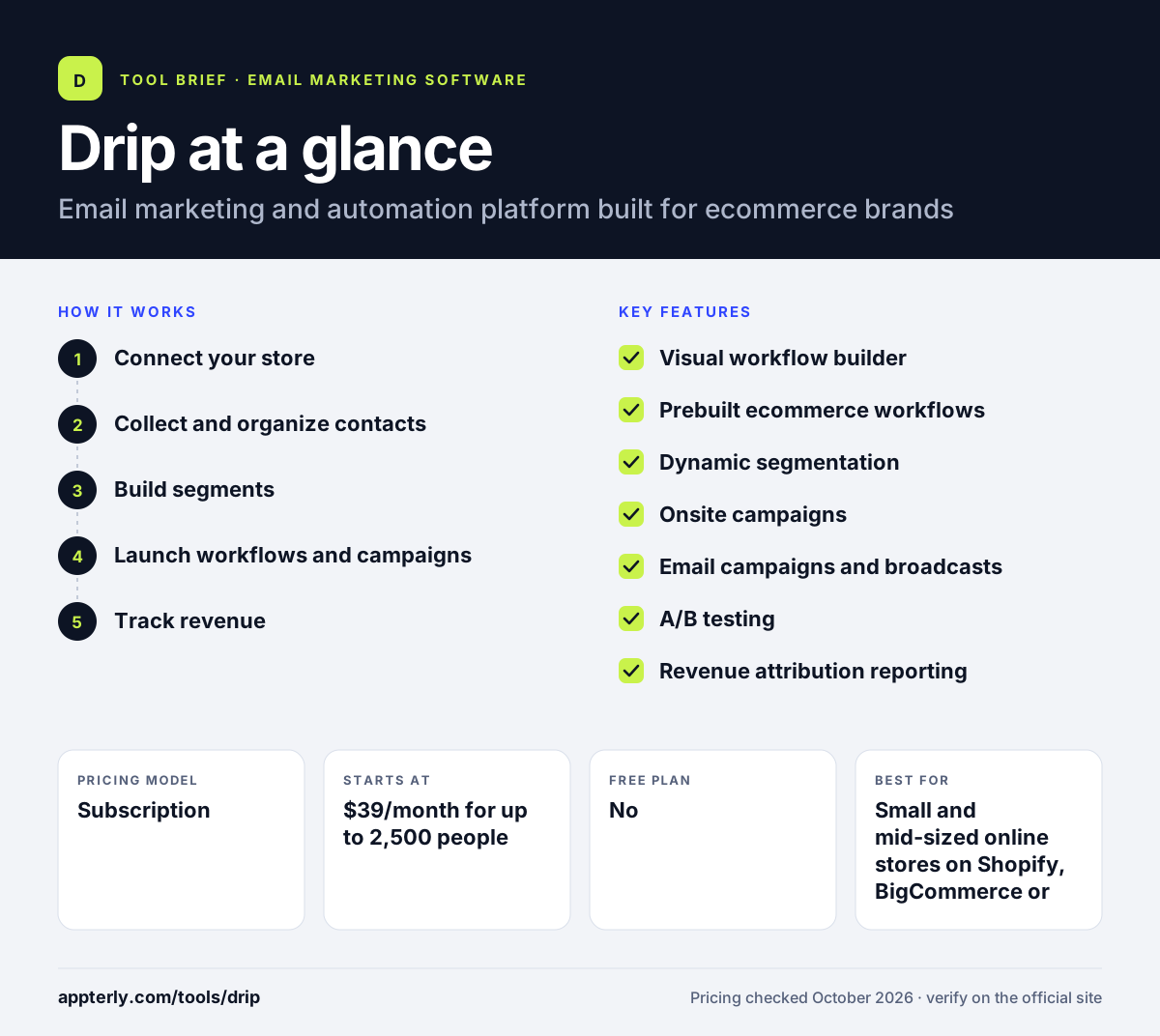
Drip at a glance
How does Drip work?
- Connect your store
Link Shopify, BigCommerce, WooCommerce or another supported platform so customer, product and order data syncs into Drip automatically.
- Collect and organize contacts
Capture new subscribers with onsite forms and pop-ups. Drip tags each person based on actions like browsing, clicking and purchasing.
- Build segments
Create dynamic segments that update on their own, such as first-time buyers, lapsed customers or people who viewed a category but did not buy.
- Launch workflows and campaigns
Start from prebuilt workflows for welcome series, abandoned carts and post-purchase follow-ups, or design your own, then send one-off broadcasts for promotions.
- Track revenue
Review dashboards that tie opens, clicks and orders back to each workflow, campaign and broadcast so you can see what earns money.
Drip key features
Visual workflow builder
A no-code canvas for building behavior-based automations with triggers, delays, splits and actions.
Prebuilt ecommerce workflows
Ready-made flows for common store moments like cart abandonment, browse abandonment, welcome and win-back.
Dynamic segmentation
Segments that refresh automatically based on purchases, page views, email activity and custom tags.
Onsite campaigns
Pop-ups and forms shown on your store to grow the list and promote offers, tied to the same customer data.
Email campaigns and broadcasts
Send one-off promotional emails and personalized messages to any segment alongside automated workflows.
A/B testing
Test subject lines and content in emails and workflows to find which version performs better.
Revenue attribution reporting
Dashboards that show revenue, clicks and opens for each campaign and workflow.
Open API and 90+ integrations
Connect Drip to store platforms and other tools, or send custom events through the API.
Why use Drip?
- It turns store activity into automatic, personalized emails, so customers get messages that match what they browsed or bought.
- Prebuilt ecommerce workflows let a small team launch cart recovery and post-purchase flows quickly.
- Revenue attribution shows which emails actually drive sales rather than just opens.
- Unlimited email sends on the entry plan make pricing more predictable as you send more campaigns.
- Free migration and personalized onboarding lower the effort of switching from another email tool.
Who is Drip best for?
A good fit for
- Small and mid-sized online stores on Shopify, BigCommerce or WooCommerce
- Ecommerce marketers who want behavior-based automation without code
- DTC brands focused on repeat purchases and customer loyalty
- Agencies managing several store brands, since sub-accounts are included
Less suited to
- Bloggers, creators or nonprofits that only need a simple newsletter, since there is no free plan
- B2B companies that need sales pipelines and deal tracking
- Brands that want SMS built into the same entry-level plan
Drip pricing
| Pricing model | Subscription |
|---|---|
| Free plan | No |
| Free trial | 14 days |
| Starting price | $39/month for up to 2,500 people |
Price rises with the number of active people on your list and your monthly send volume. The entry plan includes unlimited email sends and up to 50 workflows, and larger lists move to higher tiers.
Prices checked October 2026. Vendors change plans often, so confirm on the official Drip pricing page before you buy.
Drip pros and cons
Pros
- Strong focus on ecommerce data, segmentation and automation
- Prebuilt workflows for the most common store revenue flows
- Clear revenue reporting per campaign and workflow
- Unlimited sends and sub-accounts on the starting plan
Cons
- No free plan, and the entry price is higher than basic newsletter tools
- Built mainly for online stores, so it is less suited to other business types
- Live chat support appears tied to higher-priced plans
Drip integrations and platforms
Works with
Available on
Drip alternatives
See the full shortlist in Best Email Marketing Software.
Drip FAQ
Is Drip free?
No. Drip does not offer a free plan. It offers a 14-day free trial with no credit card required, and paid plans start at $39 per month for up to 2,500 people. The trial includes most features, though unlimited email sends are not available until you upgrade to a paid plan.
What is Drip used for?
Drip is used by online stores to send automated, personalized email marketing. It pulls in customer and order data from platforms such as Shopify and WooCommerce, then uses that data for segments, abandoned cart emails, welcome series, post-purchase follow-ups, onsite pop-ups and revenue reporting.
Does Drip integrate with Shopify?
Yes. Drip connects with Shopify, as well as BigCommerce and WooCommerce, and lists more than 90 integrations overall. Once connected, store data such as orders, products and cart activity syncs into customer profiles, which you can use to trigger workflows and build segments without manual exports.
Drip vs Klaviyo: what's the difference?
Both Drip and Klaviyo target ecommerce brands with data-driven email automation. Klaviyo is a broader platform that adds SMS, reviews, customer service tools and a customer data platform, and it has a free plan. Drip focuses more narrowly on email and onsite campaigns, with a paid entry plan that includes unlimited sends.
Is Drip good for beginners?
Drip is manageable for beginners who run an online store, because it offers prebuilt workflows, no-code automation, free migration and personalized onboarding. Someone who only needs a basic newsletter may find it more than they need, and the lack of a free plan makes it a bigger first commitment.
Sources
This overview is based on Drip's official website and documentation, checked October 2026.