What is Semrush?
Semrush is an online marketing suite that helps teams research keywords, track rankings, audit websites, analyze backlinks and measure how often their brand appears in AI search answers. Its core tools include the Keyword Magic Tool, Position Tracking, Site Audit and Backlink Analytics, and its flagship plan, Semrush One, pairs classic SEO data with AI visibility tracking. Adobe completed its purchase of the company in April 2026.
The platform is split into toolkits. Besides SEO and the Semrush AI Toolkit for AI visibility, there is the Content Toolkit (the successor to ContentShake), Semrush Local for listings and local rankings, an Advertising Toolkit for PPC research, a Traffic and Market Toolkit and Semrush Social. The App Center adds paid apps such as Semrush AdClarity for ad intelligence and Semrush Brand Monitoring for tracking mentions.
Semrush at a glance
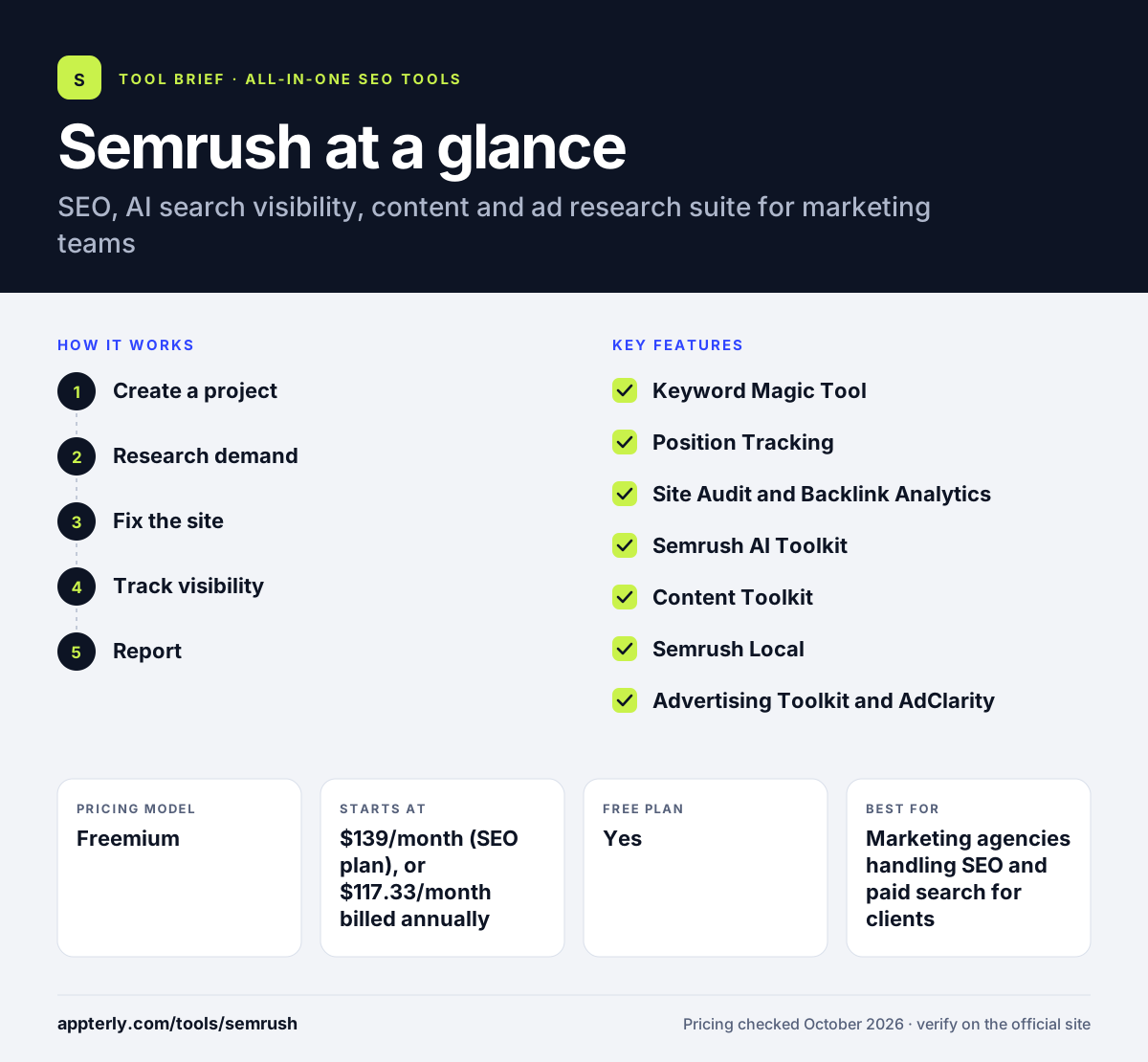
How does Semrush work?
- Create a project
Add your domain, then set the competitors and target locations you want to watch.
- Research demand
Find keywords in the Keyword Magic Tool, compare gaps with competitors and check AI prompts your audience uses.
- Fix the site
Run Site Audit to catch crawl, speed and on-page issues, then track progress over repeat audits.
- Track visibility
Monitor Google rankings in Position Tracking and brand mentions in AI answers through the AI visibility tools.
- Report
Build marketing reports or connect data to Looker Studio and share them with clients or managers.
Semrush key features
Keyword Magic Tool
Generates large keyword lists with volume, difficulty and intent filters for SEO and PPC planning.
Position Tracking
Daily rank tracking by device and location, with multi-location tracking on higher tiers.
Site Audit and Backlink Analytics
Technical health checks plus link profile research for your site and competitors.
Semrush AI Toolkit
Tracks how your brand shows up in AI assistants and AI search, including prompt research and sentiment.
Content Toolkit
AI-assisted content planning and writing, which replaced the earlier ContentShake app.
Semrush Local
Manages business listings and tracks local map rankings.
Advertising Toolkit and AdClarity
PPC keyword and ad research, with AdClarity adding display and video ad intelligence as an App Center app.
Semrush Brand Monitoring
An App Center app that tracks brand and competitor mentions across the web.
Why use Semrush?
- One subscription covers keyword research, rank tracking, audits and backlinks.
- AI visibility tracking shows how brands appear in AI answers alongside Google rankings.
- Toolkits and apps let teams add content, local, ads or social features as needed.
- A free plan allows limited daily reports before committing to a paid tier.
- An API and MCP access let teams pipe data into their own tools and AI assistants.
Who is Semrush best for?
A good fit for
- Marketing agencies handling SEO and paid search for clients
- In-house SEO and content teams at growing companies
- PPC managers researching competitor ads and keywords
- Brands tracking visibility in AI search tools
Less suited to
- Small sites on a tight budget, since paid plans start well above $100 a month
- Users who want everything in one price, as toolkits and apps are billed separately
- Beginners who only need a simple keyword tool
Semrush pricing
| Pricing model | Freemium |
|---|---|
| Free plan | Yes |
| Free trial | 7 days |
| Starting price | $139/month (SEO plan), or $117.33/month billed annually |
Starter is $199/month and Pro+ $299/month, adding more tracked sites, keywords, AI prompts and historical data, while Advanced is custom. Extra users, reports and App Center apps cost extra.
Prices checked October 2026. Vendors change plans often, so confirm on the official Semrush pricing page before you buy.
Semrush pros and cons
Pros
- Very broad toolset across SEO, content, local and ads
- AI visibility tracking built into main plans
- Free plan for light use
- Large App Center for extra capabilities
Cons
- Expensive for freelancers and small businesses
- Costs add up with extra users, toolkits and apps
- The number of tools can overwhelm new users
Semrush integrations and platforms
Works with
Available on
Semrush alternatives
See the full shortlist in Best SEO Tools.
Semrush FAQ
Is Semrush free?
Semrush has a free plan with no credit card required. It includes one demo project, 10 reports per day across core tools and some AI visibility features. Paid plans also come with a 7-day free trial. Serious SEO work usually needs a paid plan, which starts at $139 a month or $117.33 a month billed yearly.
What is Semrush used for?
Semrush is used for keyword research, rank tracking, technical site audits, backlink analysis and competitor research. Marketing teams also use Semrush to track brand visibility in AI search, plan and write content, manage local listings, research competitor ads and build client reports, depending on which toolkits and apps they add.
Is Semrush good for beginners?
Semrush can work for beginners, but there is a learning curve. The free plan and trial let new users explore tools like the Keyword Magic Tool and Site Audit, and the knowledge base covers each feature. Beginners with one small site may find the price and the number of tools more than they need.
Semrush vs SE Ranking: what's the difference?
Semrush offers a wider range of toolkits, including advertising research, market data, social media and an app marketplace, plus a free plan. SE Ranking covers core SEO tasks such as rank tracking, audits and research at a lower starting price and focuses on agency reporting. Both now track AI search visibility.
Who owns Semrush?
Adobe owns Semrush. Adobe completed the acquisition on April 28, 2026. Semrush has said existing contracts, features, support and billing were not changed immediately after the deal, and the product continues to operate under the Semrush brand while integration work takes place.
Sources
This overview is based on Semrush's official website and documentation, checked October 2026.