What is Pencil?
Pencil is a generative AI platform that helps marketing teams create, score and launch ad creative, including images, videos and copy, within one brand-safe workspace. It brings together models from several AI providers, such as OpenAI, Google, Adobe, Runway and Stability AI, so teams can pick the best model for each task without managing separate accounts. Pencil serves solo founders on self-serve plans as well as global brands with strict legal and IT needs.
Pencil works through AI agents and multi-step workflows. A workflow might take a product image and a text brief, generate background scenes, turn them into short videos and write matching ad copy. Real-time AI scores help predict which creative is likely to perform before it goes live. Ads can then be launched and tracked on channels like Meta, TikTok, YouTube, Google Display and LinkedIn. Large brands like L'Oreal and Unilever appear as Pencil customers on its website.
Pencil at a glance
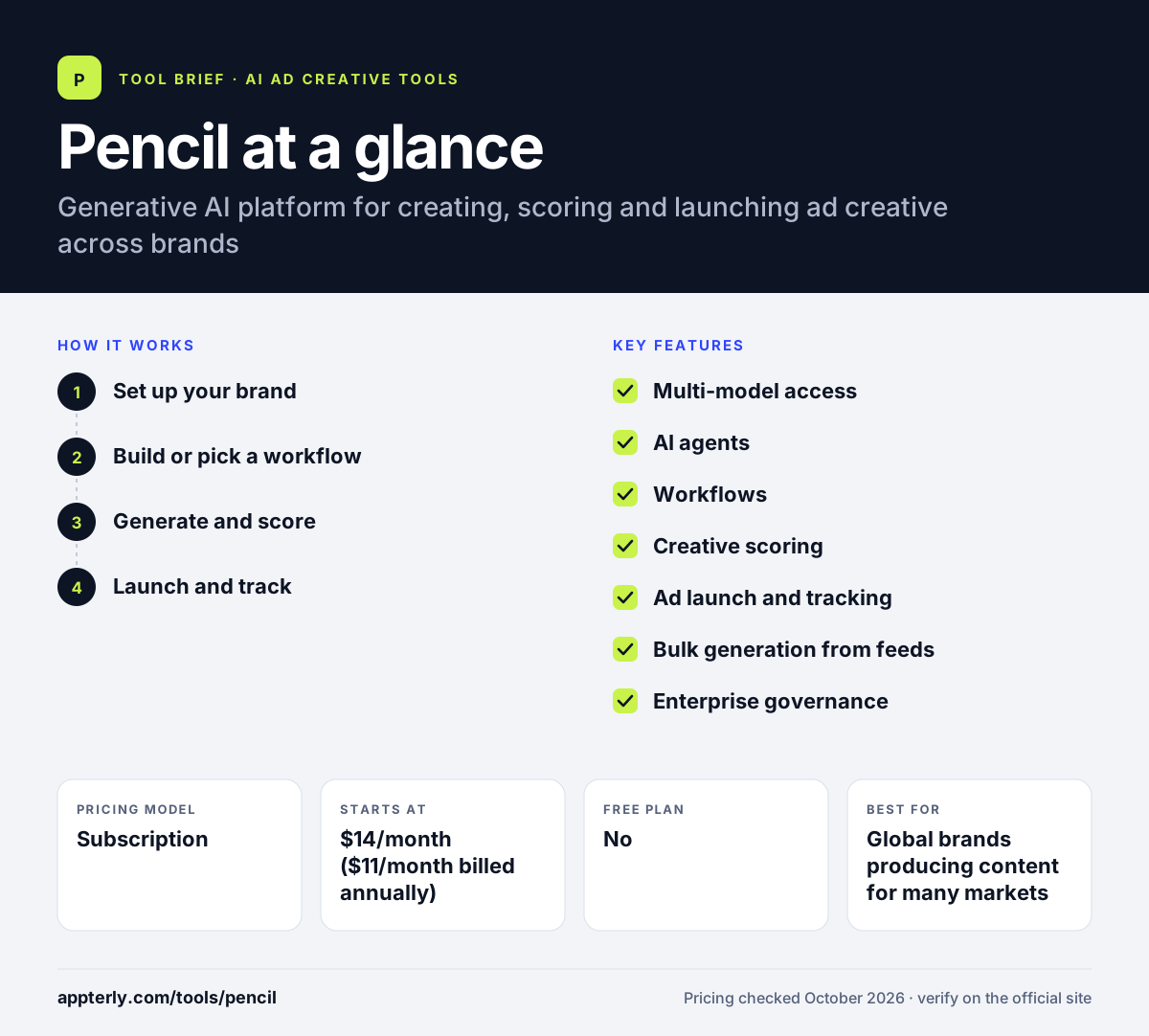
How does Pencil work?
- Set up your brand
Add brand assets, products and guidelines so Pencil's agents generate content that follows your standards.
- Build or pick a workflow
Connect inputs such as prompts, product shots and references to generation steps for images, video and copy.
- Generate and score
Run the workflow to produce ad variations, then review AI insights and scores to choose the strongest ones.
- Launch and track
Publish ads to channels like Facebook, Instagram, TikTok, YouTube and LinkedIn, and monitor results inside Pencil.
Pencil key features
Multi-model access
Combines models from OpenAI, Google, Adobe, Runway, Stability AI and others in one place, which avoids lock-in to a single provider.
AI agents
Agents generate text, images, video and finished ad creatives while following brand rules. Teams can review and edit outputs before using them.
Workflows
Chains steps into repeatable production pipelines, such as turning a product photo into several video ads.
Creative scoring
Gives real-time AI insights and scores on creative so teams can prioritize stronger ads before spending budget.
Ad launch and tracking
Launches and tracks ads on Facebook, Instagram, TikTok, YouTube, Google Display, DV360 and LinkedIn.
Bulk generation from feeds
On the Pro plan, Pencil can generate creative in bulk from product feeds for large catalogs and many markets.
Enterprise governance
Offers SOC 2 Type II, a no-train commitment on customer data, IP ownership of outputs and role-based access.
Why use Pencil?
- It gives access to many leading AI models without separate subscriptions.
- Workflows turn repetitive creative production into a repeatable process.
- Creative scores help teams decide what to launch before spending money.
- Entry plans are low cost for solo entrepreneurs testing AI ads.
- Enterprise controls address legal and IP concerns about generative AI.
Who is Pencil best for?
A good fit for
- Global brands producing content for many markets
- Ecommerce and DTC founders testing AI ad creative
- In-house creative teams scaling video and image production
- Enterprises needing governance over generative AI
- Agencies producing AI creative for several brand clients
Less suited to
- Teams that only need simple static graphics
- Heavy users on Core, which includes 50 generations per month
- Marketers wanting a permanent free plan
Pencil pricing
| Pricing model | Subscription |
|---|---|
| Free plan | No |
| Free trial | Free guided trial to create six ads |
| Starting price | $14/month ($11/month billed annually) |
Core is $14/month for 50 generations and one workspace, and Growth is $55/month for 250 generations and unlimited workspaces. Annual billing saves 20%, and the Pro enterprise plan is custom priced with unlimited generations.
Prices checked October 2026. Vendors change plans often, so confirm on the official Pencil pricing page before you buy.
Pencil pros and cons
Pros
- Many AI models in one platform
- Affordable entry plans for small teams
- Built-in creative scoring and launch tools
- Strong enterprise governance and IP terms
Cons
- Generation limits on lower plans are tight
- Enterprise features need a custom contract
- Workflows take time to set up well
Pencil integrations and platforms
Works with
Available on
Pencil alternatives
See the full shortlist in Best AI Ad Creative Generators.
Pencil FAQ
Is Pencil free?
Pencil has no permanent free plan, but you can sign up and create six ads for free through a guided experience. Paid plans start with Core at $14 per month, or $11 per month billed annually, for 50 generations. Growth costs $55 per month for 250 generations, and the Pro enterprise plan is custom priced.
What is Pencil AI used for?
Pencil is used to produce ad creative with generative AI. Marketing teams generate images, videos and copy for ads, score the results to predict performance and launch them on channels such as Meta, TikTok, YouTube and LinkedIn. Large brands also use Pencil to scale content across many markets with governance controls.
Who owns Pencil?
Pencil is operated by Pencil AI Limited, and its website displays The Brandtech Group branding, which has been reported as Pencil's owner. Brandtech is a marketing technology group that works with large consumer brands, which helps explain Pencil's focus on enterprise governance, multi-market production and brand safety.
Pencil vs Omneky: what's the difference?
Both are AI ad creative platforms. Pencil focuses on combining many AI models, building production workflows and enterprise governance, with plans from $14 per month. Omneky builds a brand kit from your website, creates image, video and avatar ads and launches them to nine channels, with plans from $29 per month. Pick based on workflow depth versus fast setup.
Is Pencil good for beginners?
Yes. Beginners can start with the free guided experience, which walks through creating six ads, and then move to the low-cost Core plan. More advanced features, such as custom workflows and bulk feed generation, take longer to learn and are aimed at larger teams with ongoing production needs.
Sources
This overview is based on Pencil's official website and documentation, checked October 2026.