What is Bouncer?
Bouncer is an email verification platform that checks whether email addresses are valid and safe to send to. You can upload a list in the web app, verify addresses in real time through an API, or flag fake signups with Bouncer Shield. The goal is to cut bounces, protect sender reputation and make email campaigns more effective by removing bad or risky addresses before you send.
Bouncer has grown beyond basic verification. Its Toxicity Check scores lists for risky addresses such as spam traps and breached accounts, and its Deliverability Kit tests inbox placement, authentication and blocklists. Other features include data enrichment, engagement insights and AutoClean, which keeps a connected CRM clean automatically. The service is hosted in the EU and is GDPR compliant, which matters for European senders.
Bouncer at a glance
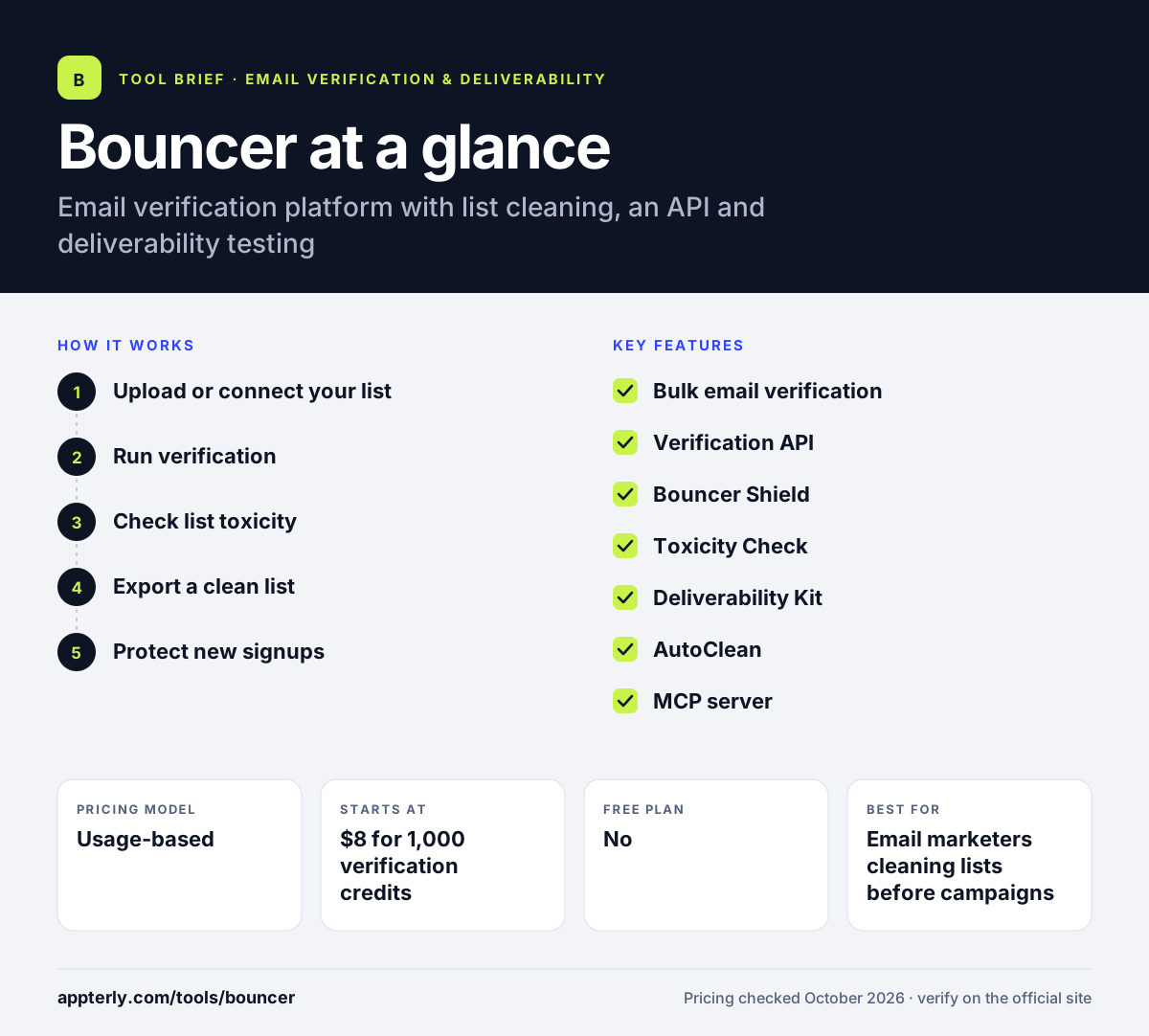
How does Bouncer work?
- Upload or connect your list
Upload a file in the web app, connect a marketing platform or CRM, or send addresses through the API.
- Run verification
Bouncer checks each address and labels it as deliverable, risky, undeliverable or unknown.
- Check list toxicity
Optionally run Toxicity Check to spot addresses linked to spam traps, breaches or complainers.
- Export a clean list
Download the results or sync them back, keeping only safe addresses for your next campaign.
- Protect new signups
Use the API or Bouncer Shield on forms so invalid or fraudulent emails are caught at entry.
Bouncer key features
Bulk email verification
Clean large lists in the web app and get clear status labels for each address.
Verification API
Synchronous and asynchronous endpoints for checking emails inside your own apps and forms.
Bouncer Shield
Flags invalid, malicious or fraudulent signups based on the email and IP address.
Toxicity Check
Scores addresses from 0 to 5 for risk factors like spam traps and breached accounts.
Deliverability Kit
Inbox placement tests, SPF, DKIM and DMARC checks, and blocklist monitoring.
AutoClean
Connects to a CRM and keeps contact data clean on an ongoing basis.
MCP server
Lets AI assistants such as ChatGPT and Claude call Bouncer verification directly.
Why use Bouncer?
- Removing invalid addresses lowers bounce rates and protects your sender reputation.
- Credits never expire, so you can buy in bulk and use them when needed.
- You are not charged for duplicates or unknown results.
- EU hosting and GDPR compliance help European businesses meet data rules.
- Deliverability testing and verification live in one account.
Who is Bouncer best for?
A good fit for
- Email marketers cleaning lists before campaigns
- Cold email senders who need low bounce rates
- SaaS products validating signups through an API
- European companies that want EU-hosted data processing
Less suited to
- Users looking for a tool that also sends campaigns
- Very small senders who only verify a few addresses a year
- Teams that need a free ongoing plan beyond starter credits
Bouncer pricing
| Pricing model | Usage-based |
|---|---|
| Free plan | No |
| Free trial | 100 free credits |
| Starting price | $8 for 1,000 verification credits |
Verification is pay-as-you-go, with the per-credit cost dropping at larger packages up to 1,000,000 credits for $2,000. The Deliverability Kit is a separate subscription starting at $25/month.
Prices checked October 2026. Vendors change plans often, so confirm on the official Bouncer pricing page before you buy.
Bouncer pros and cons
Pros
- Credits never expire
- No charge for duplicates or unknown results
- Extra tools for toxicity scoring and deliverability testing
- EU-hosted and GDPR compliant
Cons
- No ongoing free plan beyond starter credits
- Deliverability Kit and Shield are billed separately
- Specific marketing platform integrations are not listed clearly on the homepage
Bouncer integrations and platforms
Works with
Available on
Bouncer alternatives
See the full shortlist in Best Email Verification Tools.
Bouncer FAQ
Is Bouncer free?
Bouncer gives new users 100 free credits with no credit card required, which is enough to test the service. After that, verification is paid on a pay-as-you-go basis, starting at $8 for 1,000 credits. Credits never expire, and you are not charged for duplicate addresses or unknown results.
What is Bouncer used for?
Bouncer is used to clean email lists and validate addresses before sending. Marketers upload lists to remove invalid and risky contacts, developers use the API to check signups in real time, and teams use the Deliverability Kit to test inbox placement and monitor blocklists. The result is fewer bounces and a healthier sender reputation.
Bouncer vs ZeroBounce: what's the difference?
Both Bouncer and ZeroBounce verify email lists and offer APIs. Bouncer stresses EU hosting, GDPR compliance, a toxicity score and credits that never expire. ZeroBounce offers a broader set of extras such as email scoring and its own sending tools. Pricing per verification is similar, so compliance needs and extra features usually decide.
How accurate is Bouncer email verification?
Bouncer checks each address and returns a status such as deliverable, risky, undeliverable or unknown. It backs its results with an accuracy guarantee and does not charge for unknown results. No verifier can be perfect for catch-all domains, so risky results should be handled with care in campaigns.
Does Bouncer have an API?
Yes. Bouncer offers an email verification API with both synchronous endpoints for real-time checks and asynchronous endpoints for batches. It also provides an MCP server so AI assistants can verify emails directly. Developers use the API to validate signups and keep CRM data clean.
Sources
This overview is based on Bouncer's official website and documentation, checked October 2026.