What is Yext?
Yext is an enterprise brand visibility platform that stores verified business data in a central Knowledge Graph and distributes it to search engines, maps, directories and AI assistants. Its best-known product, Yext Listings, updates location details across more than 200 publishers through direct API connections. Yext serves large brands in financial services, healthcare, retail, food service and hospitality.
Beyond Listings, Yext offers Reviews, Pages, Search, Social and Email products, plus Scout, which shows where a brand gains or loses visibility in AI and search down to individual locations. Following its deal for Hearsay Systems announced in 2024, it also sells compliant social and messaging tools for financial advisors. Yext was founded in 2006, went public on the New York Stock Exchange in 2017 and operates from New York City.
Yext at a glance
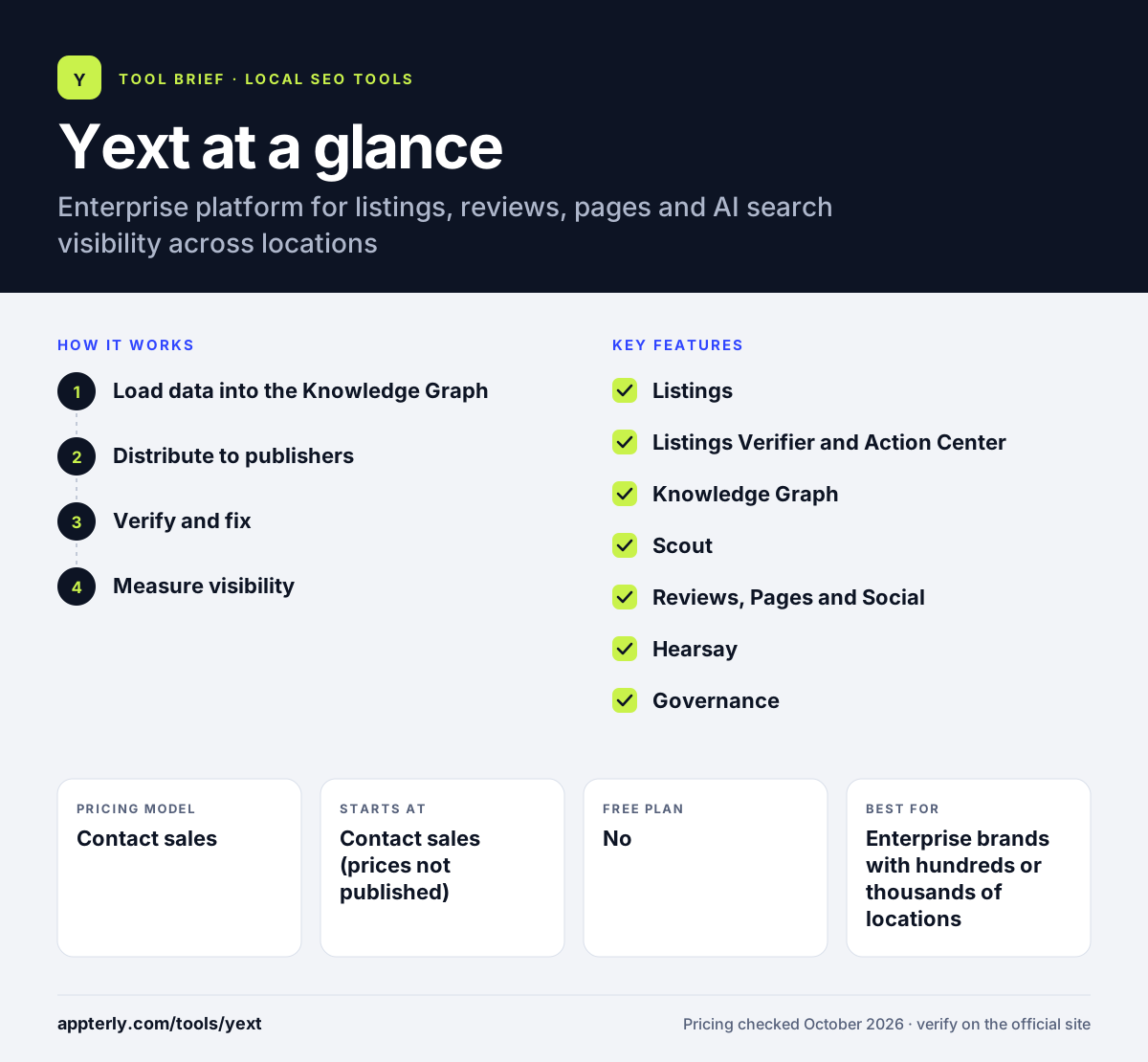
How does Yext work?
- Load data into the Knowledge Graph
Store location details, hours, menus, providers and other facts in one central database.
- Distribute to publishers
Yext pushes the data directly to over 200 publishers, including Google, Apple Maps, Yelp and AI assistants.
- Verify and fix
The Listings Verifier compares live listings with your data, and the Action Center pushes corrections.
- Measure visibility
Track impressions, clicks, calls and AI citations by location, and use Scout for competitive insight. Teams can review results by publisher, region or individual store.
Yext key features
Listings
Manages more than 50 profile fields across 200+ direct publisher integrations, including AI assistants.
Listings Verifier and Action Center
Detects errors, duplicates and overwrites, then pushes fixes to all publishers.
Knowledge Graph
A central source of brand data that feeds every Yext product and external AI agents via API and MCP.
Scout
Shows competitive visibility in search and AI answers at the location level.
Reviews, Pages and Social
Additional products for review management, local landing pages and social publishing.
Hearsay
Compliant social and one-to-one client engagement tools for financial services firms.
Governance
Role-based approvals and audit trails for large, distributed teams.
Analytics
Reports impressions, clicks, calls and direction requests by publisher and location, plus AI citations against local competitors.
Why use Yext?
- Direct publisher connections let updates reach many sites quickly.
- One Knowledge Graph keeps data consistent across every channel.
- AI search tracking shows how brands appear in assistants like ChatGPT and Gemini.
- Strong governance suits regulated industries such as healthcare and finance.
- APIs and MCP support let teams plug brand data into their own AI agents.
- Industry options cover details like menus, insurance plans and advisor disclosures.
Who is Yext best for?
A good fit for
- Enterprise brands with hundreds or thousands of locations
- Healthcare systems managing provider listings
- Banks and financial advisors needing compliant engagement
- Restaurant and retail chains syncing menus and inventory details
- Franchise marketing teams coordinating local managers
Less suited to
- Single-location small businesses
- Teams wanting transparent self-serve pricing
- Budgets that cannot support an enterprise contract
- Agencies seeking a white-label reseller tool with simple monthly plans
Yext pricing
| Pricing model | Contact sales |
|---|---|
| Free plan | No |
| Free trial | Not confirmed |
| Starting price | Contact sales (prices not published) |
Yext sells through demos and custom contracts. Cost depends on the products chosen, the number of locations and contract length. Buyers typically combine Listings with optional products such as Reviews, Pages or Search, and each adds to the contract value.
Prices checked October 2026. Vendors change plans often, so confirm on the official website before you buy.
Yext pros and cons
Pros
- Large direct publisher network
- Wide product range from listings to AI search
- Enterprise-grade governance and APIs
Cons
- No published pricing
- Complex and costly for small businesses
- Several capabilities are sold as separate products
- Smaller teams may not use enough of the platform to justify the cost
Yext integrations and platforms
Works with
Available on
Yext alternatives
See the full shortlist in Best Local SEO Tools.
Yext FAQ
How much does Yext cost?
Yext does not list prices on its website. Pricing is quoted after a demo and depends on which products you buy, how many locations you manage and the contract term. It is generally positioned as an enterprise platform, so small businesses often choose lower-cost listing tools instead.
What is Yext used for?
Yext is used to manage brand and location information across the web. Companies store facts in its Knowledge Graph and push them to search engines, maps, directories and AI assistants. Yext also covers reviews, local pages, site search, social publishing and AI visibility insights.
Yext vs Uberall: what's the difference?
Both platforms target brands with many locations. Yext is built around its Knowledge Graph, a direct publisher network and AI search products like Scout, plus Hearsay tools for finance. Uberall packages listings, reviews and local social into plan bundles with GEO tools. Both require a sales conversation for pricing.
Does Yext work with AI search tools?
Yes. Yext structures listing data for AI assistants such as ChatGPT and Gemini, tracks how AI answers cite a brand against local competitors, and lets companies connect their own AI agents to the Knowledge Graph through MCP and API access.
Is Yext a public company?
Yes. Yext completed its IPO on the New York Stock Exchange in 2017 and trades under the ticker YEXT. The company was founded in 2006 in New York City and in 2024 agreed to acquire Hearsay Systems, a client engagement provider for financial services.
Sources
This overview is based on Yext's official website and documentation, checked October 2026.