What is Synup?
Synup is a local marketing platform that uses an AI agent called Sydekick to handle business listings, reviews, social posts, local SEO and AI search visibility. It keeps profiles accurate across directories, publishers and voice assistants, and lets teams run local marketing for one or many locations. Synup serves agencies, software platforms reselling local services, multi-location brands, franchises and small businesses.
A key part of Synup is its agency setup: a multi-client command center, a client portal, team permissions and a white-label option on Premium plans and above. It also builds store locators and local landing pages, and shows how AI engines such as ChatGPT, Gemini and Perplexity describe a business. Every plan includes every feature, so pricing depends on the number of locations and AI credits rather than on feature tiers.
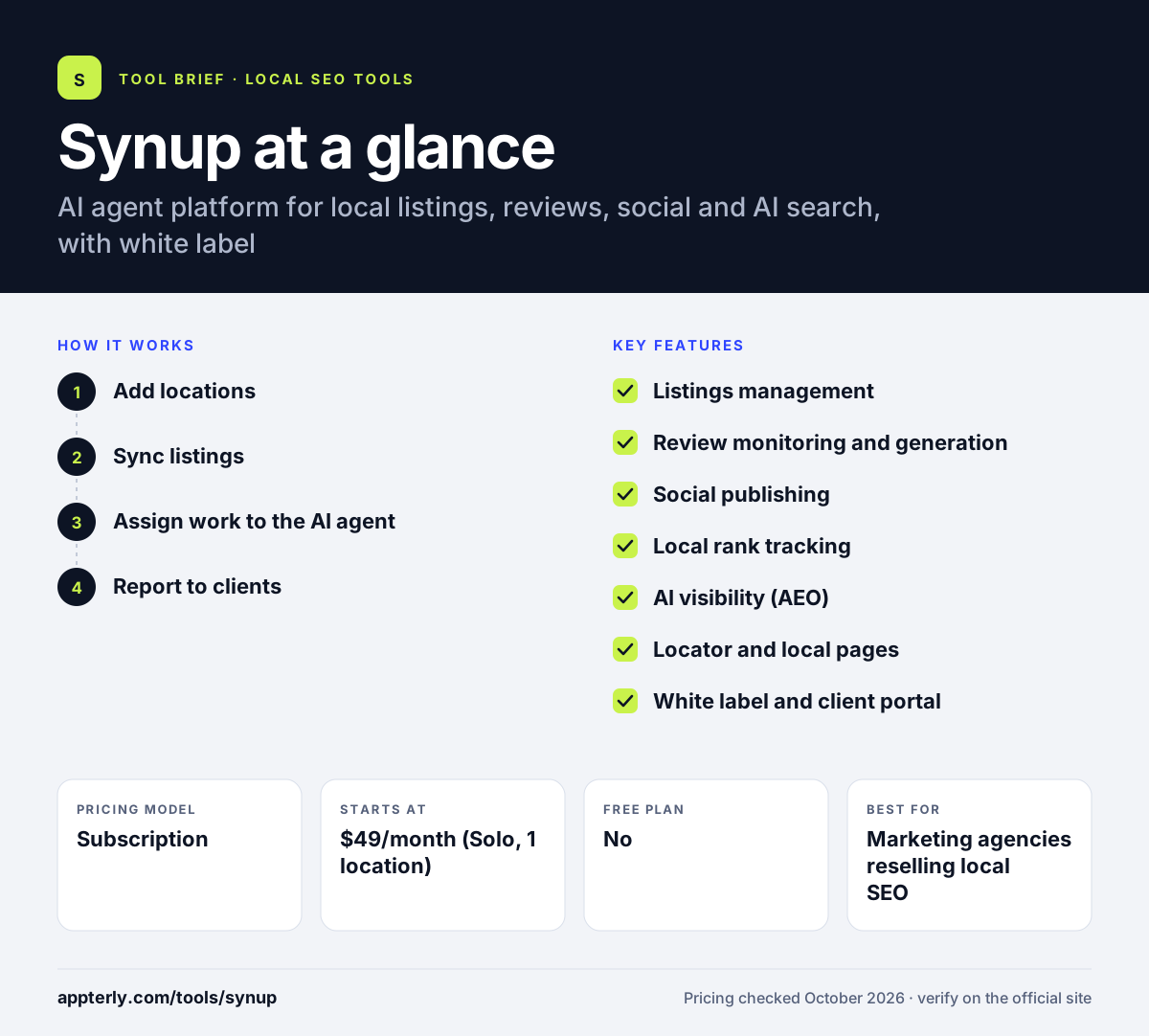
Synup at a glance
How does Synup work?
- Add locations
Start a 14-day trial on the Solo plan and add each business location or service area.
- Sync listings
Synup publishes business details to Google Business Profile, Apple Business Connect, Bing, Facebook and a wider publisher network.
- Assign work to the AI agent
Sydekick handles tasks across reviews, social posting and SEO, using monthly credits included with the plan.
- Report to clients
Agencies share results through a branded client portal and track rankings and AI visibility over time.
Synup key features
Listings management
Keeps business information consistent across directories, data aggregators and voice assistants.
Review monitoring and generation
Tracks reviews from many sources and helps request new ones.
Social publishing
Schedules and posts content across locations from one calendar.
Local rank tracking
Monitors local search positions for target keywords.
AI visibility (AEO)
Shows how ChatGPT, Gemini and Perplexity describe the business.
Locator and local pages
Creates store locators and landing pages for each location.
White label and client portal
Lets agencies resell Synup under their own brand and domain from the Premium plan.
Why use Synup?
- All features are included on every plan, so there is no feature gating.
- White labeling helps agencies resell local marketing as their own service.
- One platform covers listings, reviews, social and AI search.
- Per-location costs drop as accounts move to larger bands.
- Integrations with Slack, HubSpot and MCP connectors fit modern workflows.
Who is Synup best for?
A good fit for
- Marketing agencies reselling local SEO
- Multi-location brands and franchises
- Software platforms adding local marketing to their offer
- Single-location businesses wanting an AI-driven setup
Less suited to
- Businesses that only need a basic rank tracker
- Small agencies with two or three clients, since the jump from Solo to Premium is large
- Teams wanting white label during the trial, which is not included
Synup pricing
| Pricing model | Subscription |
|---|---|
| Free plan | No |
| Free trial | 14 days |
| Starting price | $49/month (Solo, 1 location) |
Plans scale by location count and AI credits: Premium is $299/month for up to 10 locations, Pro $499 for up to 25 and Scale $899 for up to 50, with Enterprise pricing above that. Annual terms save about 20%.
Prices checked October 2026. Vendors change plans often, so confirm on the official Synup pricing page before you buy.
Synup pros and cons
Pros
- Every feature available on every plan
- Strong agency tools including white label
- Covers AI search visibility alongside classic local SEO
- Free trial available
Cons
- Large price gap between the one-location and ten-location plans
- AI agent work pauses when monthly credits run out
- White label is not available on Solo or during the trial
Synup integrations and platforms
Works with
Available on
Synup alternatives
See the full shortlist in Best Local SEO Tools.
Synup FAQ
How much does Synup cost?
Synup starts at $49 per month for the Solo plan with one location. Premium costs $299 per month for up to 10 locations, Pro is $499 for up to 25 and Scale is $899 for up to 50. Enterprise pricing is custom. Annual terms offer a discount of about 20 percent.
Does Synup have a free trial?
Yes. Synup offers a 14-day free trial that lets you explore the Solo plan. White labeling is not included during the trial. If you start a paid Premium subscription directly, you are billed right away and the trial does not apply.
What is Synup used for?
Synup is used to manage local marketing for one or many business locations. It syncs listings across directories, monitors and requests reviews, schedules social posts, tracks local rankings and checks how AI search tools describe a brand. Agencies use its white-label portal to deliver these services to clients.
Synup vs Yext: what's the difference?
Yext is an enterprise platform sold through custom contracts, with its own large publisher network and AI search tools. Synup publishes transparent location-based plans, includes every feature on each tier and offers white labeling, which makes it popular with agencies and mid-size multi-location businesses.
Can agencies white label Synup?
Yes. White labeling is available on the Premium plan and above. It removes Synup branding so clients see the agency's brand and domain. Agencies also get a multi-client command center, a client portal and team permissions to manage many accounts.
Sources
This overview is based on Synup's official website and documentation, checked October 2026.