What is HARO?
HARO, short for Help a Reporter Out, is a free matchmaking service that connects journalists who need expert input with people who can supply it. Reporters post a query with their topic, the kind of source they want and a deadline. HARO then bundles open queries into email digests that go out to registered sources, who reply directly with a pitch. If the reporter uses the answer, the source is usually credited, often with a link.
The service began in 2008 when Peter Shankman started it as a Facebook group that grew into an email list. Vocus bought it in 2010, and it became a Cision brand after the 2014 merger. Cision renamed it Connectively in 2024 and closed it that December. Featured.com bought HARO in April 2025, and the relaunched version, often listed as HARO (Featured), runs again as a free service funded by newsletter advertising.
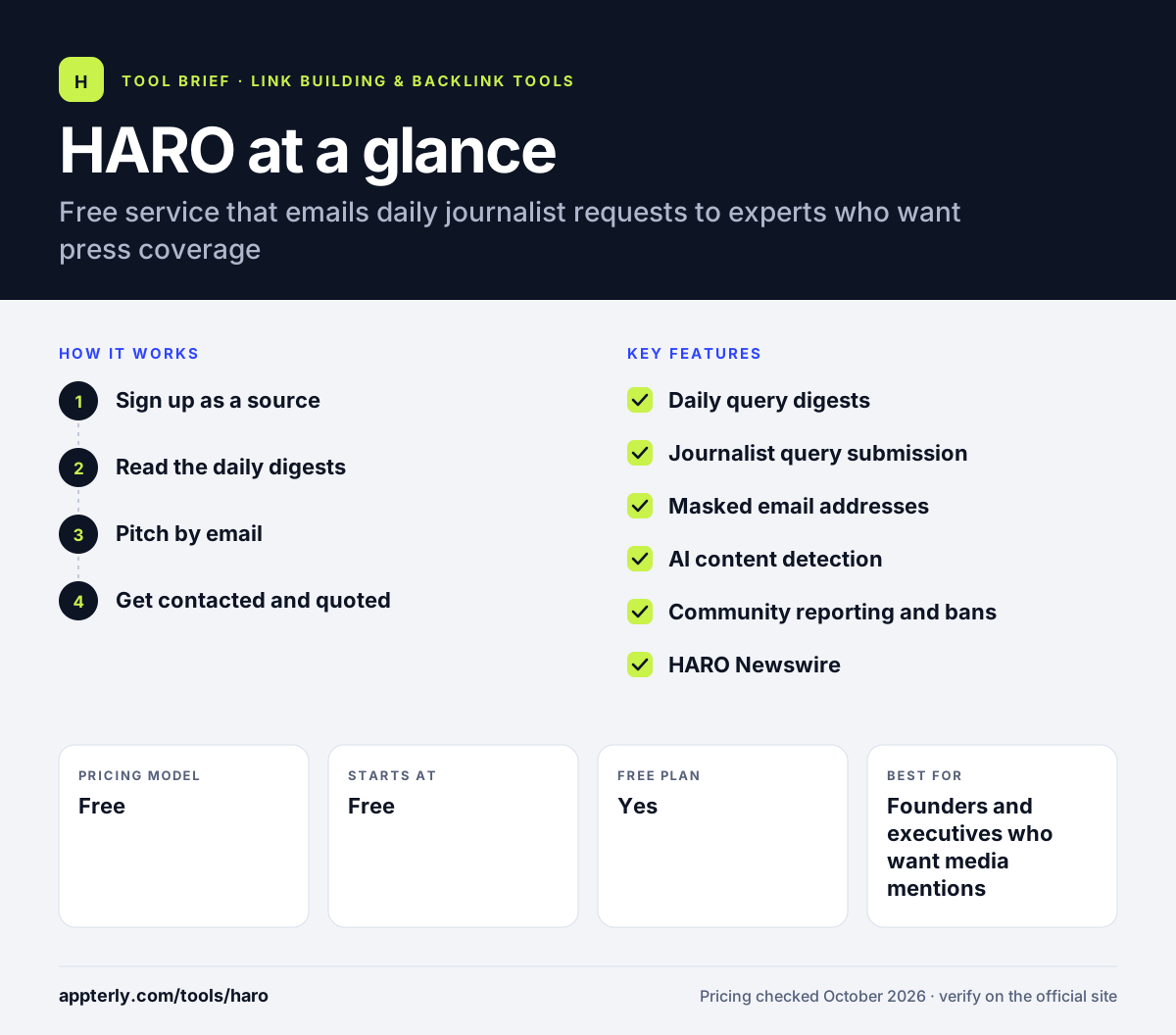
HARO at a glance
How does HARO work?
- Sign up as a source
Create a free account and choose to receive media query emails. Journalists sign up separately to post requests.
- Read the daily digests
Registered sources receive up to three digest emails each weekday, each listing open journalist queries with topics and deadlines.
- Pitch by email
Reply to the queries that fit your expertise with a short, useful answer and your credentials. Email addresses are masked to protect both sides.
- Get contacted and quoted
If a reporter picks your answer, they contact you directly. When the story runs, you are typically named and may receive a link to your site.
HARO key features
Daily query digests
Up to three emails per weekday collect fresh journalist requests in one place, so sources do not need to hunt for opportunities.
Journalist query submission
Reporters submit a request describing the expert they need, their question and their deadline at no cost.
Masked email addresses
Contact details are hidden behind masked addresses, which reduces spam and protects both journalists and sources.
AI content detection
Pitches are screened for AI-generated content to keep answers useful for reporters.
Community reporting and bans
Users can flag abuse, and policy violations can lead to lifetime bans.
HARO Newswire
A separate section of the site handles news release distribution for brands that want to publish announcements.
Why use HARO?
- HARO costs nothing for sources or journalists, so anyone can test it.
- Earned media mentions can build brand credibility in a way paid ads cannot.
- Published answers often include a link, which can support SEO and link building.
- Queries arrive in your inbox, so the time cost is mostly reading and pitching.
- It suits subject experts who can answer questions quickly and clearly.
Who is HARO best for?
A good fit for
- Founders and executives who want media mentions
- SEO specialists building editorial backlinks
- PR freelancers and small agencies pitching client experts
- Consultants and niche experts building authority
Less suited to
- Teams that want guaranteed placements or predictable link volume
- People who cannot reply within short news deadlines
- Brands needing a full media database or campaign tracking
HARO pricing
| Pricing model | Free |
|---|---|
| Free plan | Yes |
| Free trial | Not confirmed |
| Starting price | Free |
HARO is free for both journalists and sources and is supported by advertising in its newsletter. Featured.com sells separate paid products, but none are required to use HARO.
Prices checked October 2026. Vendors change plans often, so confirm on the official website before you buy.
HARO pros and cons
Pros
- Completely free for sources and journalists
- Opportunities delivered by email each weekday
- Can produce authoritative editorial links
- Safety measures such as masked emails and AI screening
Cons
- Competition for each query is high, so many pitches go unanswered
- No tracking dashboard to measure results
- Coverage and links are never guaranteed
HARO integrations and platforms
Available on
HARO alternatives
See the full shortlist in Best Link Building Tools.
HARO FAQ
Is HARO still available?
Yes. HARO was shut down by Cision in December 2024 after a short period under the Connectively name. Featured.com acquired it in April 2025 and relaunched it as a free email service. Sources can again sign up to receive daily journalist queries, and reporters can submit requests through the HARO website.
Is HARO free?
Yes. HARO is free for both journalists and expert sources. The relaunched service is funded through ads placed in its email newsletter rather than subscriptions. You can sign up, receive up to three digests each weekday and pitch reporters without paying. Featured.com, which runs HARO, offers other paid products separately.
What is HARO used for?
HARO is used to connect journalists with experts. Reporters use it to find sources for stories, and businesses use it to earn press mentions. Many SEO professionals also use HARO for link building, since published articles often credit the source with a link to their website. Those links tend to come from established news and media sites.
HARO vs Qwoted: what's the difference?
Both connect journalists with expert sources. HARO is free and works mainly through email digests that you answer by email. Qwoted is a web platform with expert profiles, a searchable database and a free plan limited to a few pitches each month, plus paid plans for more pitches and faster delivery. HARO is simpler, while Qwoted offers more structure.
How do I get featured through HARO?
Sign up as a source, scan each digest for queries that match your expertise and reply quickly. Answer the exact question in a few clear sentences, add your name, title and website, and avoid generic or AI-written text. Responding early and staying on topic gives your pitch the best chance of being chosen.
Sources
This overview is based on HARO's official website and documentation, checked October 2026.